

Double Benefit: Electricity and Nutrition from the Land
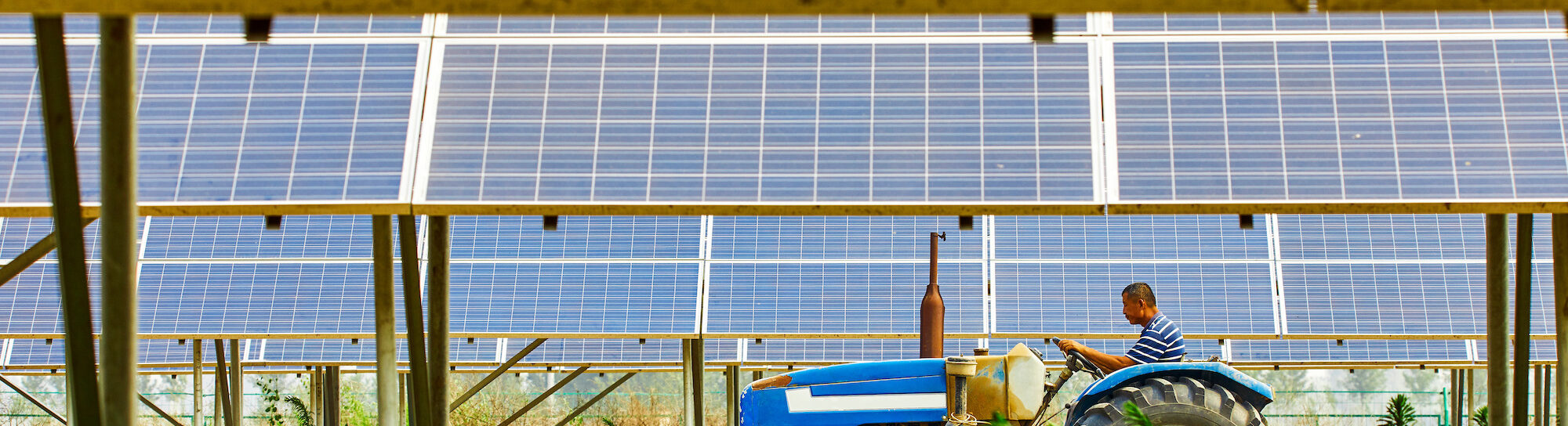
The demand for both food and electricity is set to increase dramatically in future. Concurrently, there will be less free space available. So why don’t we use arable land to produce both food and electricity at the same time? This would be possible using solar panels that produce electricity several meters above the ground. Plants that need shady conditions could grow beneath them.
Tuesday, August 9, 2022
The worldwide population growth is causing increasing demand for food. At the same time, however, more electricity will also be needed. This is all the more true for countries that want to break away from fossil fuels in the foreseeable future. Less gas and oil – i.e. decarbonization – means an increase in electrification. Against the background of the fact that usable land will also be scarcer, it makes sense to consider multiple use of agricultural land. According to the “Tages-Anzeiger” newspaper, one option in this area would be agrivoltaics.
Twofold Use
The idea: Solar panels can be installed on agricultural land that provide electricity and do not prevent plants from growing underneath at the same time. There are various options for setting up the panels. For example, three to five meters above the field. This means that there is still enough space for agricultural machinery to go underneath them. In pastures, cows could also graze under the panels. In the hot summer months they would have sufficient shade. Switzerland, with its numerous pastures, would be the perfect place to do this. However, it is also conceivable that the panels could be installed standing vertically with several meters of space between them. The challenge is to position the photovoltaic systems in such a way as to maximize both harvests and electricity production. It would also be conceivable to have mobile modules that could adjust to the sunlight according to the time of year. This would mean that in winter, when certain plants need less sun or the fields are fallow, electricity production could be maximized. In summer, the panels can be set up so that sufficient light gets to the plants.
Increasing Productivity
The idea of agrivoltaics improves land use efficiency. In certain cases, agricultural productivity can even be increased with solar panels. “There are examples where the productivity of agriculture has increased, in spite of the partial shade caused by the photovoltaic systems, because the micro-climate under the solar panels can be adjusted to the plants in a targeted manner,” Jürg Rohrer, Professor of Ecological Engineering at Zurich University of Applied Sciences (ZUAS) in Wädenswil tells the “Tages-Anzeiger”.
Protection against Wind and Weather
The solar panels also protect the crops from wind and weather. Depending on the design, the systems provide protection from heat, hail, heavy rail or even frost. This could even make the technology attractive for winegrowers, who regularly have to battle hail and frost. Against the background of climate change with the increasing likelihood of extreme weather, agrivoltaics could be a way to mitigate the consequences, according to Rohrer in the “Tages-Anzeiger”. During a trial conducted by ZUAS in Wädenswil, researchers observed that in winter more lamb’s lettuce actually grew under the panels than in fields without panels. According to Rohrer, this is due to the fact that the temperature under the panels could be kept higher.
Switzerland Lagging Behind
In countries such as the Netherlands, France, Germany and the USA, agrivoltaics systems of various types are already in use. In some cases, for example in Germany, they are even state-funded. In spite of the huge potential of agrivoltaics, to date it has not been permitted in Switzerland. However, this could change in future thanks to the government’s amendment of the Raumplanungsverordnung [Land-use Planning Ordinance]. In actual fact, however, agrivoltaics systems may initially only be used in very restricted areas. This is because, among other things, there are clashes with landscape and nature conservation. But that is not the only problem. The government is also responsible for the shabby treatment of agrivoltaics according to Christian Wolf, Sales Manager at MBR Solar. According to the Federal Office for Agriculture (FOAG), systems of this kind can only be built if it can be proved that they offer added value for agriculture. This must be greater than the added value of energy production. “This means that agrivoltaics can actually only be considered for special crops such as berries. The contribution margin (CM) is present there, and extra agricultural yield can be achieved,” Wolf tells the “BauernZeitung” farming newspaper. In spite of huge potential, it is therefore possible that agrivoltaics systems will not be able to be installed with pip and stone fruits. This is because the coverage ratio there is three to four times lower. Wolf finds the FOAG’s position incomprehensible.
Gaining Valuable Experience
According to David Stickelberger from Swiss Solar, only sites close to residential areas are currently considered for agrivoltaics. This is because in other areas it would be necessary to lay long, expensive power lines. Alongside the problems with regulation, however, there is still a significant need for research in this area. This is because there has been no final clarification of how to optimize electricity production and food production in the same area. According to Jürg Rohrer, it is now important to set up a few large systems to gain experience. He says, “there is simply nothing better than gaining practical experience, otherwise you can often be talking at cross purposes.”
Related articles
Legionella, Japanese beetles, and market turbulences: What are the consequences of the dry heatwave summer 2026?
How do persistent heat and drought in the summer of 2026 impact health, agriculture, and the economy? The summer of 2026 exemplifies how heat and dry conditions are becoming a threat across various areas: from cooling systems and livestock housing to crops and consumer wallets.

Unwanted Invaders: Why Pesticides Are Essential in the Fight Against Invasive Species
They are small, highly mobile and extremely persistent: invasive species are spreading increasingly across Switzerland. Whether it is the Japanese beetle, the Asian hornet or newly discovered ant species, these unwelcome guests threaten not only native ecosystems, but also agriculture and residential areas. There is an urgent need for pesticides – including biocides and plant protection products – to combat these pests effectively.

What can the CRISPR gene scissors do – and what not (yet)?
Since 2012, CRISPR/Cas has made it possible to alter plant DNA precisely, purposefully, and relatively cheaply. Applications ready for use today primarily include disease resistance, improved quality such as taste and nutritional value, and accelerated breeding. In contrast, complex traits like drought tolerance remain difficult because many genes are involved.

Cheap Spanish Tomatoes Are a Thing of the Past – Now Innovation Is Needed
Fewer and fewer crop protection products, increasing pest pressure and retailers demanding low prices: Spain’s vegetable production is caught in a dilemma that also affects Switzerland. The only way out is through plant breeding and digitalisation.