

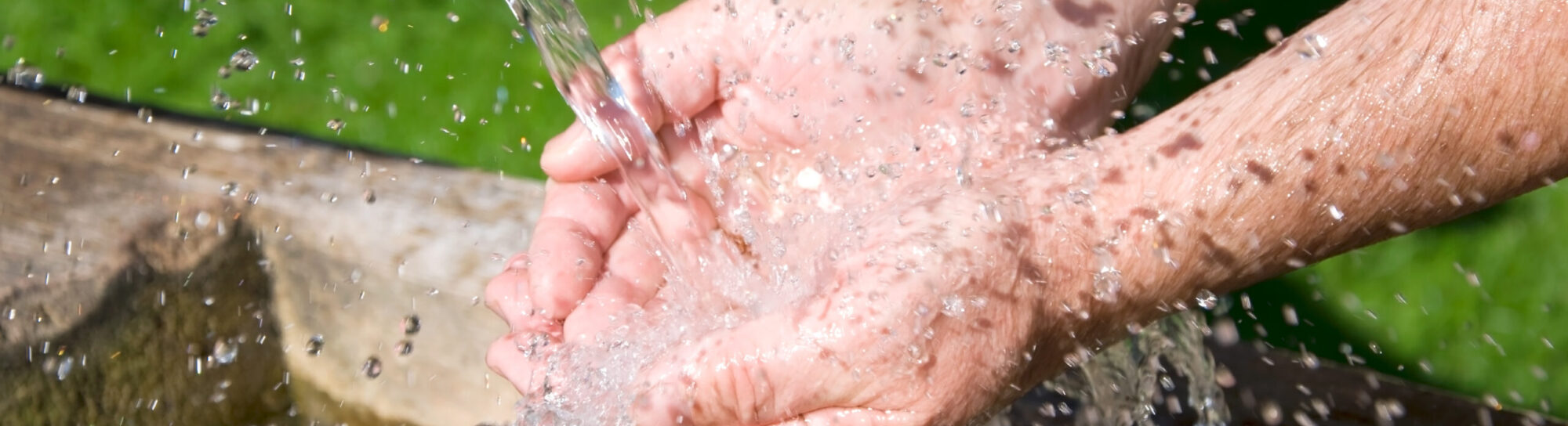
Scientists urge common sense
The second swiss-food-talk was attended by three internationally recognised experts from the fields of toxicology, water protection and food safety. They discussed the handling of limit values and the partly wrong interpretation in the public discourse. The scientists pleaded for more objectivity.
Published: 31.08.2020, 00:00 | Updated: 28.05.2024, 13:46
Content in German
«We have to distinguish between health-related limits and politically set limits. This is always mixed up», says Rex FitzGerald, Regulatory Toxicologist at the Swiss Centre for Applied Human Toxicology (SCAHT) in Basel. Health-related limits define the dose that has no harmful effect despite lifelong and daily consumption. There are also legal limits that have nothing to do with health risk.
The value of 0.1 micrograms per litre set for drinking water is not based on a risk assessment, but expresses the political will to have no residues for precautionary reasons. This value is not suitable for assessing the health risk. «If we speak of toxic water because it exceeds 0.1 micrograms per litre, this is fundamentally wrong», says the toxicologist, who carries out risk assessments on behalf of the authorities. He is perplexed as to why this is nevertheless repeatedly reported in the media.
On the right track
Dr Manfred Röttele, project manager of the European water protection initiative TOPPS, explained just how low the limit value for pesticides in water is: «To dilute one gram of an active ingredient to the existing limit value of 0.1 micrograms per litre, you need a stream one metre wide, 30 centimetres deep and 33 kilometres long.» It goes without saying that undesirable inputs into groundwater should be avoided wherever possible. Good agricultural practice is essential. TOPPS supports users and offers the relevant expertise. In this way, pesticide inputs into the groundwater can be significantly reduced. «The direction is right. The contamination of groundwater by pesticides is decreasing», says Röttele.
Discrepancy between perception and danger
Jo Riehle, food chemist and pesticide expert from Hamburg, dares to explain why the public often senses danger at the slightest residue. In his opinion, the heated debate has to do with the so-called uncertainty avoidance index. This is very high in Germany – but probably also in Switzerland. The fear of the unknown leads to the establishment of rigid rules, regulations and laws.
«One driver of the discussion, however, is the vastly improved analytics. Today, we can find anything if we look for it», says Riehle. «The fact that fewer different active substances were found in the past also has to do with resistance management. There are fewer ‹one-fits-all› products today. Today's pesticides have a much more specific effect.» From an ecological point of view, this makes sense. At the same time, however, a greater number of different substances are found. This in turn would be perceived as «dangerous» by the public, says Riehle. There is also the fear of «multiple residues». «However, the mere detectability of different substances does not mean a higher health risk», says the pesticide expert.
The topic is complex. The speakers would like to see a more objective debate and call for common sense. This is precisely the aim of swiss-food.ch.
Related articles

Without biocides, animal welfare and food safety suffer
At the Swiss-Food Talk, three experts underlined the importance of biocides for agriculture and food processing. The conclusion of the talk: without biocides, food safety and animal welfare could not be guaranteed.
Content in German
New breeding methods – here to stay
The Swiss Parliament has decided to update the genetic engineering moratorium that has been in place since 2005. The step was overdue. On the occasion of a webinar organized by swiss-food.ch, experts from science and agriculture spoke about the benefits of new biotechnological breeding methods. It became clear: the risks are low, the opportunities are great.
You can't do without healthy, high-quality food from Switzerland
At the Swiss-Food Talk, three recognised experts gave answers to current questions in connection with a healthy, sustainable diet. And made an appeal to common sense.
Content in German
Challenges and opportunities of sustainable agriculture
Tomorrow's agriculture must produce more efficiently. And at the same time protect the climate and biodiversity. At the Swiss-Food Talk, three renowned, independent experts spoke about the challenges and opportunities of tomorrow's sustainable agriculture.
Content in German
A Hint to Politicians, Delivered by Test Tube
Switzerland's top science prize goes to a researcher who helped develop the "gene scissors", a technology that has decisively advanced agriculture. While science has long since opened up new possibilities and the EU is moving ahead on regulation, Switzerland continues to dawdle.

Full Shelves – Of course! How Secure Is Our Supply Really?
Security of supply sounds like a shared goal. However, as soon as it comes to the path to get there, conflicts arise: between market and state, ecology and production, as well as self-sufficiency and international connectivity. The Agricultural Policy Podcast and swiss-food.ch explore the key dependencies and areas of tension surrounding supply security in a five-part series. The highlight will be a live podcast in front of an audience on November 5, 2026, at the Äusserer Stand (Hofcafé) in Bern.
Is Organic More Sustainable?
Organic food is considered a prime example of sustainability – but in reality, it often ends up in the waste bin faster than conventional products. The omission of artificial preservatives and modern plant protection drastically shortens shelf life and leads to more food waste.
"Natural is healthy, chemicals are toxic."
Everything that occurs in nature is healthy and synthetically produced substances, i.e. "chemical" substances, are toxic. This myth is fundamentally wrong: There are many highly toxic substances in nature, and at the same time there are many synthetic substances that are absolutely harmless.